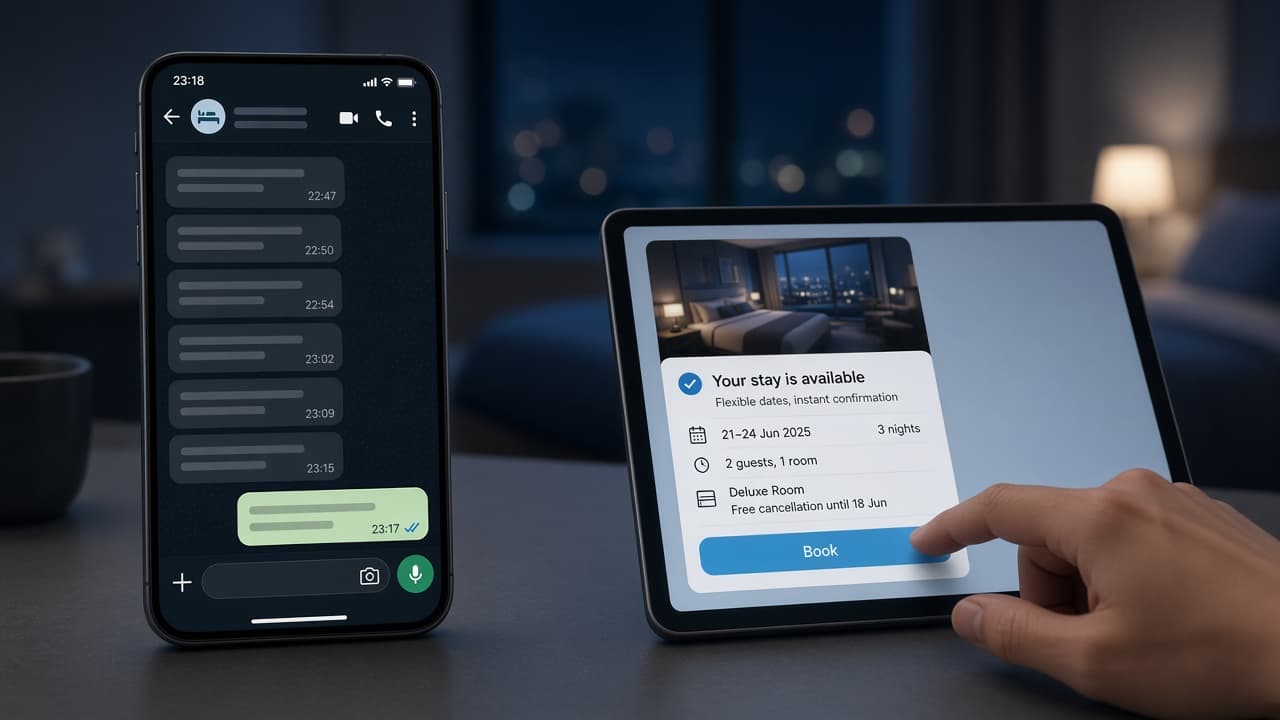
It is 11:20 p.m. A guest finds your property on Instagram, Google, or a friend tip. They open WhatsApp. They ask three things: do you have a double for Friday, what is the rate with breakfast, and can they pay now.
Nobody answers.
At 8:15 a.m. your reservations manager sees the thread. They type a careful reply. The guest already holds a confirmation from an OTA. You still get the stay, minus 15 to 25 percent commission, and the guest relationship sits with the platform.
That is not bad luck. It is a race the hotel never showed up for.
OTAs win after hours because they answer, confirm, and take payment in one tap. Most hotel front desks do not. This post maps why after-hours inquiries leak, what “instant” actually means for ops, and how to keep the booking direct without adding another overnight hire.
Why do after-hours inquiries keep leaking to OTAs?
The guest did not leave because they hated your hotel. They left because the OTA finished the job you started.
Four failure modes show up again and again in India and Gulf independents:
| What the hotel does | What the guest experiences | Where the booking goes |
|---|---|---|
| Reply next morning | Intent cooled; they already compared three options | OTA or competitor |
| Fast “yes we have rooms, please call” | Extra step; no hold, no pay, no voucher | OTA one-tap checkout |
| Quote from memory or a printed rate sheet | Wrong rate, or a rate that loses to the OTA listing | OTA (parity doubt) |
| Shared personal WhatsApp, no night coverage | Message unread until the day shift | OTA or silence |
Industry operators and hospitality tech reports in 2025 and 2026 keep pointing at the same pattern: a large share of booking-shaped inquiries arrive outside lobby hours, and delayed replies convert poorly. You do not need a contested percentage to act. Pull your own WhatsApp and missed-call timestamps for the last 90 days. Most properties are surprised by how much demand lands after 9 p.m., on weekends, and from guests in other time zones.
In India, OTA commissions for independents commonly sit in the high teens to mid-twenties (MakeMyTrip / Goibibo and peers often cited around 18 to 25 percent, with placement and boosters pushing the effective cost higher). In the Gulf, commission pressure is similar, and a shrinking booking window (many stays booked within a week of arrival) makes slow replies more expensive. Every unanswered night inquiry is not just a lost direct booking. It is often a stay you still host, rented back to you at platform rates.
What does the guest actually need at 11 p.m.?
They are not asking for a brand story. They are trying to close a decision before they sleep or board a flight.
A booking-shaped after-hours inquiry usually needs five answers:
- Availability for specific dates and occupancy
- A clear rate (room type, inclusions, taxes where you can state them)
- Confidence (cancellation basics, what happens next)
- A way to pay or hold without waiting for morning
- A confirmation they can show at the door
If any of those five is missing, the OTA still looks safer. Speed alone is not enough. A two-minute reply that says “please call reception tomorrow” still loses to Booking.com.
Voice and WhatsApp are the channels guests already use. The ops question is whether those channels can finish the booking against live inventory, or only take a note for morning.
How is this different from overnight calls and pre-arrival WhatsApp?
Three related problems get mixed up. Keep them separate so you fix the right one.
| Moment | Guest state | Failure if you only take a note | Fix |
|---|---|---|---|
| After-hours inquiry | Not yet booked; comparing options | They confirm on an OTA overnight | Instant answer + live rate + pay/hold + PMS reservation |
| Overnight service / arrival call | Booked or walking in | Night auditor overloaded; guest stuck outside | Clear ownership (desk vs reservations) + agent for booking-shaped calls |
| Pre-arrival WhatsApp | Already reserved | Preferences never reach housekeeping | Write-back to the reservation before arrival |
This post is about the first row: demand that never becomes your direct reservation because the hotel loses the overnight race. Role ownership for overnight calls and pre-arrival write-back are separate checklists. Win the inquiry first, then keep the stay clean.
What does a closed after-hours loop look like?
A working loop does not mean a chatbot that says “thanks, someone will call you.” It means the guest can leave the thread with a real booking.
- Guest calls or messages (voice or WhatsApp) outside desk hours.
- Agent answers in seconds, in the guest’s language when your stack supports it.
- Live PMS availability and rate are checked (not a stale sheet).
- Guest gets a clear quote and policy basics.
- Payment or deposit finishes in-chat (UPI / card link where you operate).
- Reservation writes back to the PMS before morning.
- Exceptions (groups, opaque rates, VIP) escalate with full context.
If step 3 or 6 is missing, you still have leakage. A charming FAQ bot that cannot see inventory will invent availability or bounce the guest to an OTA. A human who answers at midnight but cannot write the booking into the PMS creates morning chaos and double-booking risk.
Why do India and Gulf hotels feel this harder?
Three structural reasons:
WhatsApp is the front desk. Guests expect a reply on the same app they use for family and vendors. A website form or email autoresponder does not match that habit.
Lean overnight staffing. One night person often owns cash recon, late arrivals, and every inbound ring. Booking conversion is the first thing that slips.
Channel mix still leans OTA for independents. When direct capture is weak after hours, the default path for “I need a room tonight or this weekend” is MakeMyTrip, Booking.com, or Expedia. You may fill the room and still lose margin plus the next-stay relationship.
Gulf inbound and India leisure peaks also stretch across time zones. A guest browsing from Europe or a domestic traveler planning after kids’ bedtime does not care that your lobby closed at 10.
What should you measure before you buy another tool?
Start with your own logs. Tools amplify a process. They do not invent demand you refuse to see.
| Metric (last 90 days) | Why it matters |
|---|---|
| WhatsApp / missed-call volume by hour | Shows the real after-hours share |
| Median first-reply time overnight | Anything measured in hours loses to OTAs |
| Share of inquiries that become direct reservations within 24 hours | Conversion, not vanity reply counts |
| Share that later appear as OTA bookings for the same dates | Leakage you can name |
| Overnight notes that never hit the PMS | Process debt morning teams inherit |
If you cannot pull these numbers today, that is already a finding. Shared personal phones and free-app chats hide the leak.
Soft plug: how HeyKoala fits (without another overnight hire)
HeyKoala is a hotel-only agentic front desk: voice and WhatsApp against live PMS inventory, payment in the conversation, automatic write-back, and workflows trained on your SOP. Independents on common cloud PMS stacks can move in minutes for a first trial path; deeper integrated setups take days; larger enterprise work takes weeks. The published bar includes high answer rates (95 percent answer), a large share of routine work automated (around 80 percent), and meaningful recovered revenue per property per year (about $126K) when missed calls and unpaid intent stop leaking to OTAs.
The point is not another inbox for the night auditor. It is finishing the booking while the guest is still deciding, then leaving morning teams a clean reservation instead of a cold thread.
FAQ
Is after-hours leakage only a big-city problem?
No. Resort, hill, and pilgrimage markets see heavy evening and weekend planning. Smaller properties often feel it more because one phone is the whole stack.
If we already list on OTAs, why fight for direct after hours?
Because commission and guest ownership compound. A stay booked direct tonight is margin you keep and a guest you can invite back without renting the relationship again.
Can a free WhatsApp Business app solve this?
It can help one attentive person during the day. It does not give you clean multi-shift ownership, approved templates at scale, or reliable PMS write-back. Treat API vs free app as a separate decision before you promise 24/7 booking.
Won’t guests always choose the OTA for trust and cancellation?
Many will if your direct path feels vague. Match confidence: clear rate, plain cancellation basics, secure payment, instant confirmation. Speed plus certainty beats a polite “call us tomorrow.”
What is the first ops change if we cannot deploy an agent this week?
Stop leaving booking WhatsApp on one personal phone. Publish a single business number, set a night auto-reply that still routes to someone who can book, and require every overnight hold to land in the PMS before 8 a.m. Then automate the race you are already losing.
If your best inquiries still wake up as OTA confirmations, fix the after-hours close before you spend more on ads that feed the same leak.