A family in Pune opens ChatGPT on a Sunday night. "Three nights in Coorg for Diwali week, two adults, two kids, pool, under ₹12,000 a night."
Thirty seconds later they have three names. Yours is one of them.
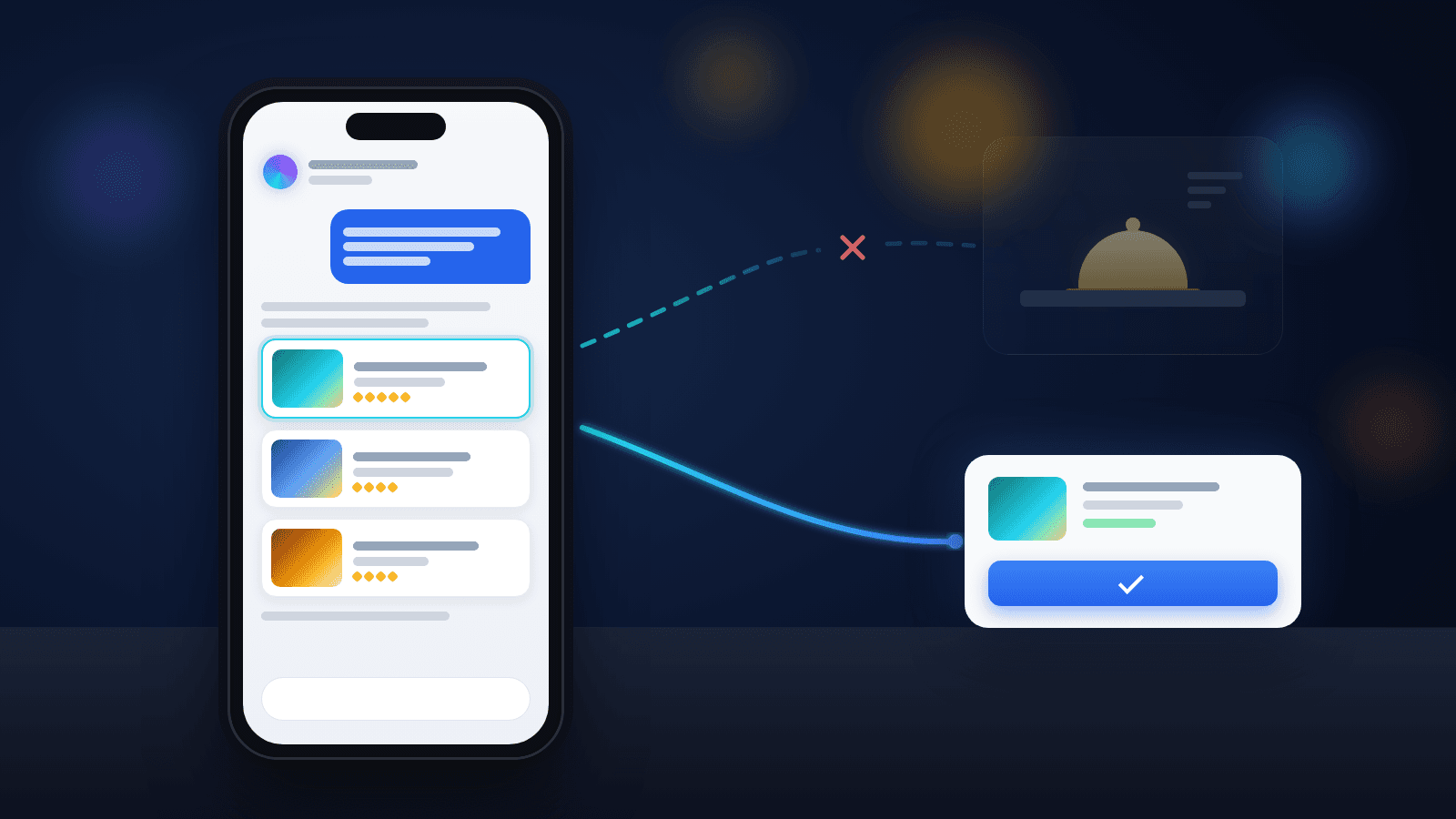
That is the good news. Here is the hard part. The assistant does not book the room. It hands the guest a link, a phone number, or a WhatsApp button. What happens in the next five minutes decides whether you get a direct booking or an OTA confirmation with 18 to 25 percent commission attached.
Most hotels are working hard on the first half of this journey. Very few have fixed the second half.
Are guests really choosing hotels through AI now?
Yes, and faster than most owners think.
Two recent studies of US travelers show the shape of it. Neither covers India or the Gulf, but the direction is clear:
| Finding (US travelers) | Source |
|---|---|
| 70% trust AI recommendations more than traditional search results | Propellic, Aug 2026 |
| ChatGPT took 47% of AI tool use, Gemini 22%, Google AI Mode 20% | Propellic, Aug 2026 |
| Most stayed inside one AI tool for a full week of trip planning | Propellic, Aug 2026 |
| 4 in 10 who used AI to book a hotel say it changed which hotel they chose | NPS Prism, 2026 |
| Only 38% of AI-assisted hotel bookings went direct. 44% landed on an OTA, 8% inside the AI tool | NPS Prism, 2026 |
Comparable India and Gulf data is still thin. You do not need it to act. Ask any front desk team whether guests now say "ChatGPT suggested you" on the phone. Then ask how those calls ended.
If AI points guests to the hotel, why do OTAs still win?
This is the part that should worry every independent.
In Propellic's recorded planning sessions with US travelers, AI told 71% of participants to book directly with the operator, and 68% said they preferred direct anyway. Guests want to book with you. The assistant is sending them your way.
Yet in the NPS Prism survey of 2,287 US travelers who used AI, only 38% of AI-assisted hotel bookings actually went direct.
The gap sits in the handoff. Propellic found that more than three quarters of booking handoffs lost key details such as travel dates and guest numbers. Participants tended to blame the travel company for that friction, not the AI tool. The guest arrives at your channel with intent, but without context, and has to start again.
Now picture where they land:
| Where the AI sends them | What often happens | Result |
|---|---|---|
| Hotel website | Booking engine resets dates, rate looks higher than the OTA tile | Back to the OTA tab |
| Phone number | Rings out at 10 p.m., or busy during check-in rush | OTA one-tap checkout |
| "Thanks, our team will revert" | Booked elsewhere by morning | |
| OTA link inside the answer | Clean checkout, instant voucher | You host the stay, pay the commission |
The assistant did its job. The hotel did not finish it. It is the same leak we mapped in Why After-Hours Hotel Inquiries Still End Up on OTAs, now arriving through a new front door.
What does an AI assistant need to recommend your hotel?
Assistants recommend what they can read, verify, and compare. Think of it as being legible, not loud.
- Plain facts on your own site. Room types, occupancy, inclusions, check-in times, cancellation basics, parking, pool, distance to landmarks. Written as clear text and tables, not buried in images or PDFs.
- Consistent details everywhere. Same name, address, phone, and WhatsApp number on your site, Google Business Profile, and OTA listings. Mismatches make assistants hedge.
- Answers to the questions guests actually ask. "Is it good for kids?" "How far from the temple?" "Is breakfast included?" A short FAQ on the page gives the assistant a sentence to quote.
- Recent, specific reviews. Assistants lean on what other guests say. Ask happy guests for detail, not stars.
- A direct path that works at any hour. If the assistant surfaces a number or a chat link, that channel must answer and book.
The first four get you on the shortlist. The fifth decides whether the shortlist pays you.
What should happen in the five minutes after the AI hands over?
Treat every AI referral as a guest who has already decided and is now testing whether you are easy to book.
A closed loop looks like this:
- Guest calls or messages on WhatsApp, often quoting the assistant.
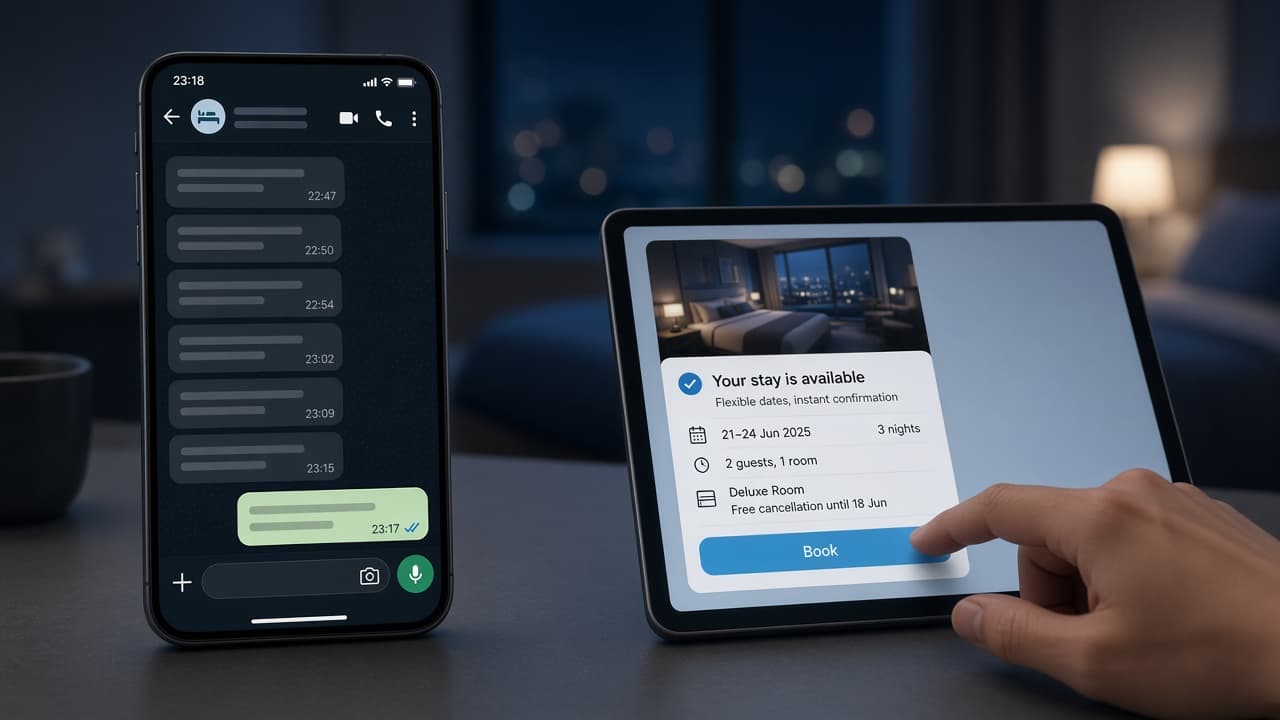
- The hotel answers in seconds, in the guest's language.
- Dates and occupancy are captured once, and never asked again.
- Live PMS availability and rate are checked, not a printed sheet.
- The guest gets a clear quote with inclusions and cancellation basics.
- Payment or deposit finishes in the same conversation (UPI or card link).
- The reservation writes back to the PMS and a confirmation goes out.
Miss step 2 and you lose the race. Miss step 4 and you quote a rate that loses to the OTA tile. Miss step 7 and morning staff inherit a chat thread instead of a booking.
Why does this hit India and Gulf hotels harder?
Festive and peak windows compress decisions. With Diwali on 8 November and the wedding season close behind, guests are shortlisting and booking in the same evening. Zee Business research puts festive travel search volumes up around 40 to 45 percent month on month this season. Every unanswered referral now costs more.
WhatsApp is where the guest goes next. When an assistant shows a WhatsApp link, Indian and Gulf guests tap it. If the reply needs a human who is off shift, the intent cools.
Lean night and weekend staffing. Planning happens after dinner and on Sundays. That is exactly when one desk person is handling arrivals, cash, and the phone.
OTA listings are already AI-readable. Aggregators publish structured price and availability. If your own channel cannot match that clarity in real time, the assistant and the guest both default to the platform.
How do you check where you stand this week?
Run a 30-minute audit before you spend on anything new.
| Test | How | What good looks like |
|---|---|---|
| Are you recommended? | Ask ChatGPT, Gemini, and Google AI Mode for your city, dates, and guest type | You appear, with correct facts |
| Are the facts right? | Compare the answer with your rate card and policies | No wrong prices, amenities, or phone numbers |
| Does the call get answered? | Call your listed number at 10 p.m. and during check-in rush | Answered in seconds, quote given |
| Does WhatsApp close? | Message your listed number with dates and occupancy | Quote, pay link, confirmation in one thread |
| Does it land in the PMS? | Check the next morning | Reservation exists, no manual re-entry |
If two or more of these fail, your AI visibility work is feeding someone else's checkout.
Where HeyKoala fits
HeyKoala is a voice AI front desk built only for hotels and resorts. When an AI assistant sends a guest to your phone line or WhatsApp, HeyKoala picks up in under a second, in 26+ languages, checks live PMS availability, quotes the right rate, sends a payment link mid-call, and writes the reservation back to your PMS. It follows your SOP for VIPs, deposits, and exceptions, and hands those to your team with full context.
The published bar: 95 percent of calls answered, 80 percent automated, and about $126K recovered per property per year when missed calls and unpaid intent stop leaking. Independent hotels can go live in about 10 minutes, with no PMS required to start. PMS integrations go live in days. Enterprise chains typically take 3 to 5 weeks for the first property.
You worked to get on the shortlist. HeyKoala makes sure the booking stays with you.
FAQ
Do I need to "optimize for ChatGPT" separately from Google?
Mostly no. The same basics win both: clear facts on your own site, consistent listings, a useful FAQ, and recent detailed reviews. The difference is that assistants quote you directly, so wrong facts travel further.
Can AI assistants book my hotel directly today?
Some are testing it. Google has begun testing agentic hotel booking, and in the NPS Prism US survey, 8% of AI-assisted hotel bookings were already completed inside the AI tool. Most guests still click through to a website, phone, or WhatsApp. That handoff is where you win or lose the booking.
Is this only relevant for big hotels with marketing teams?
No. Independents gain the most. An assistant does not care about ad budgets. It cares about clear facts and a path that books. A 30-room property that answers instantly can beat a bigger brand that sends guests to a slow form.
What if the AI shows a wrong rate or amenity for my hotel?
Fix the source. Update your website, Google Business Profile, and OTA listings so they agree. Then make sure your live channels quote from the PMS, so the guest gets the correct rate the moment they reach you.
How do I know how many bookings come from AI referrals?
Ask on every call and chat: "How did you find us?" Add "AI assistant" as an option in your PMS source codes or booking notes. A few weeks of tagging tells you more than any industry average.
CTA
AI is already recommending hotels to your next guests. Make sure the one it recommends can actually take the booking.
Free tool · no signup
What is your front desk missing each month.
Missed calls and unanswered WhatsApp never reach your PMS, so they never make the morning report. Move five sliders and see what they cost your property, per month and per year.