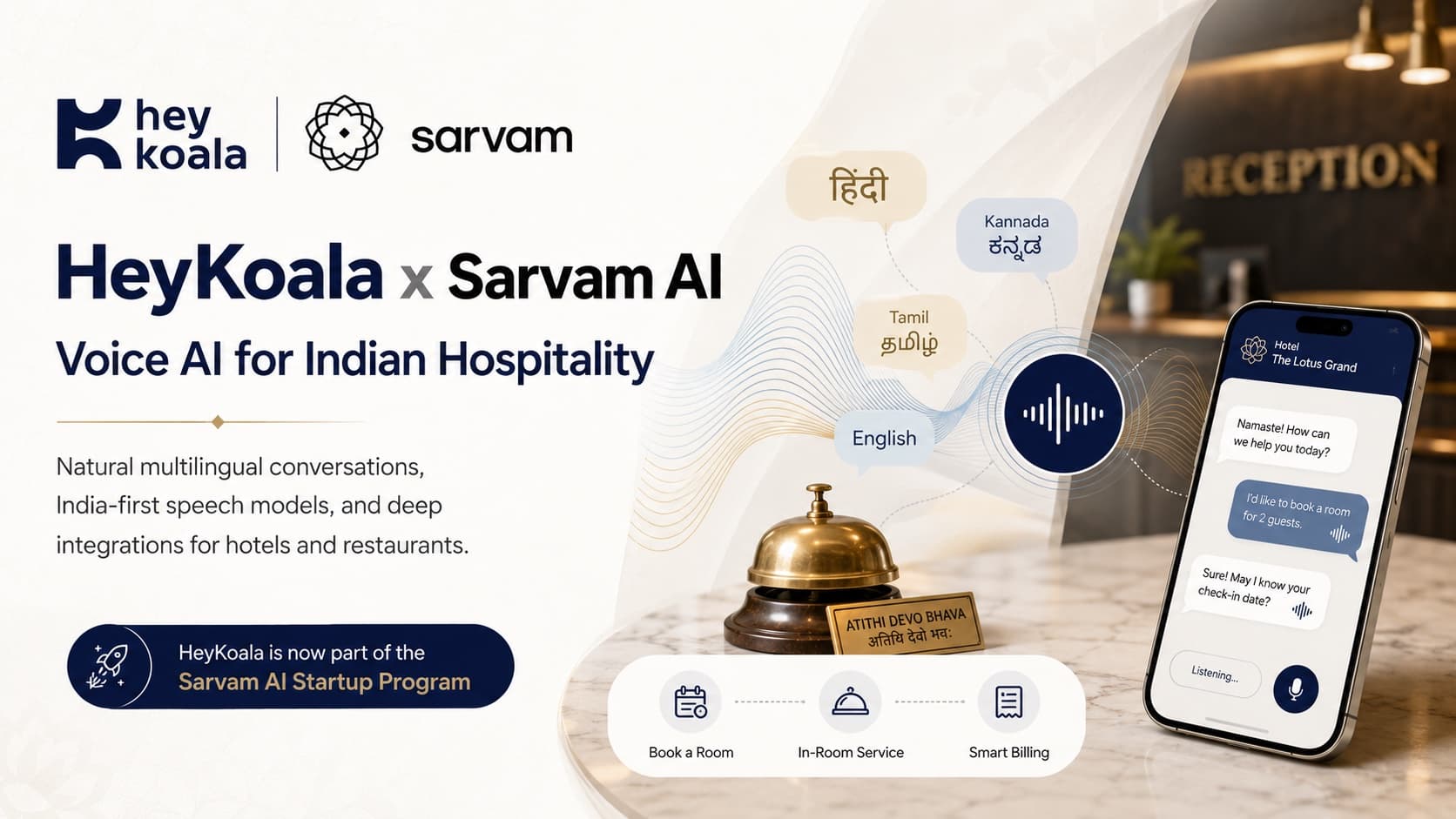
We are excited to share that HeyKoala has been selected for the Sarvam AI Startup Program.
For us, this is much more than access to another set of AI APIs. It is an opportunity to work closely with a team that is solving one of the hardest and most important technology problems in India: building artificial intelligence that understands how Indians actually speak.
The Sarvam AI Startup Program supports selected startups with production APIs, engineering access, priority support, credits aligned to their scale and opportunities for joint launch visibility. The program is designed for companies building production applications across speech, language, vision and conversational AI.
That is directly relevant to what we are building at HeyKoala.
India does not speak in language dropdowns
When a guest calls a hotel, they do not first select a language from a menu.
They might begin the conversation in English, ask about room availability in Hindi, mention the names of family members in Kannada and switch back to English while discussing dates and payment.
A restaurant customer may say:
“Two masala dosas parcel maadi, one without onion, and send the payment link on WhatsApp.”
That is not an unusual edge case. That is a normal conversation in India.
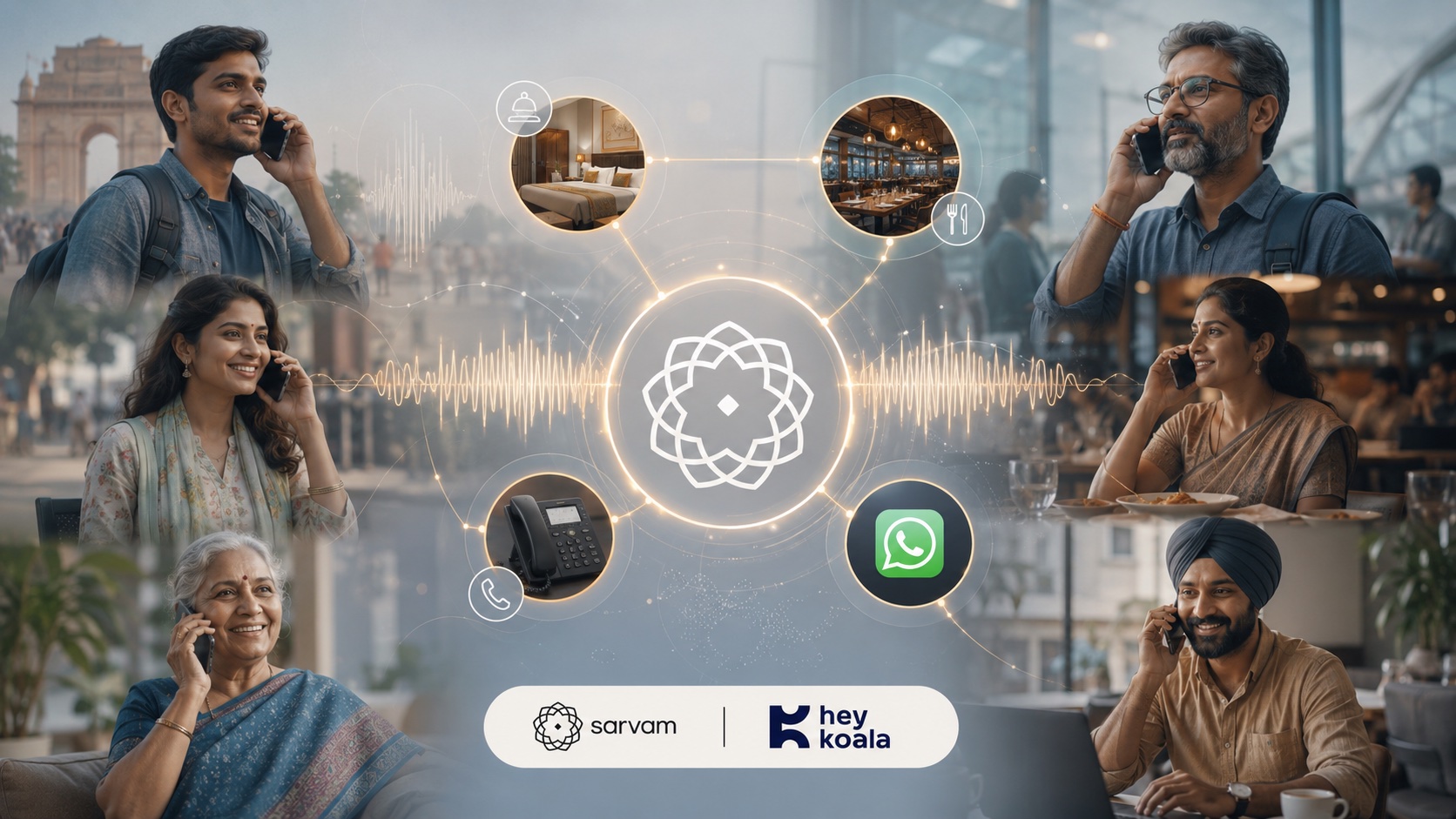
People mix languages naturally. They use English words inside regional-language sentences. They pronounce hotel names, food items, locations and dates differently based on where they come from. The same person may even switch languages depending on whether they are asking about price, explaining a dietary preference or sharing an address.
Most global speech systems were originally designed around cleaner, largely single-language conversations. They can support Indian languages, but supporting a language and understanding how that language is spoken in the real world are not always the same thing.
This is precisely the gap Sarvam is working to address.
Sarvam describes its platform as a full-stack sovereign AI platform developed, deployed and governed in India. Its models are built around Indian languages, cultural context, code-mixed speech, regional scripts and the audio conditions commonly encountered on Indian phone networks.
Why this matters for HeyKoala
HeyKoala builds AI agents for hotels, resorts, restaurants, cafés and QSRs.
Our agents do not simply answer frequently asked questions. They are connected to the systems on which hospitality businesses already operate.
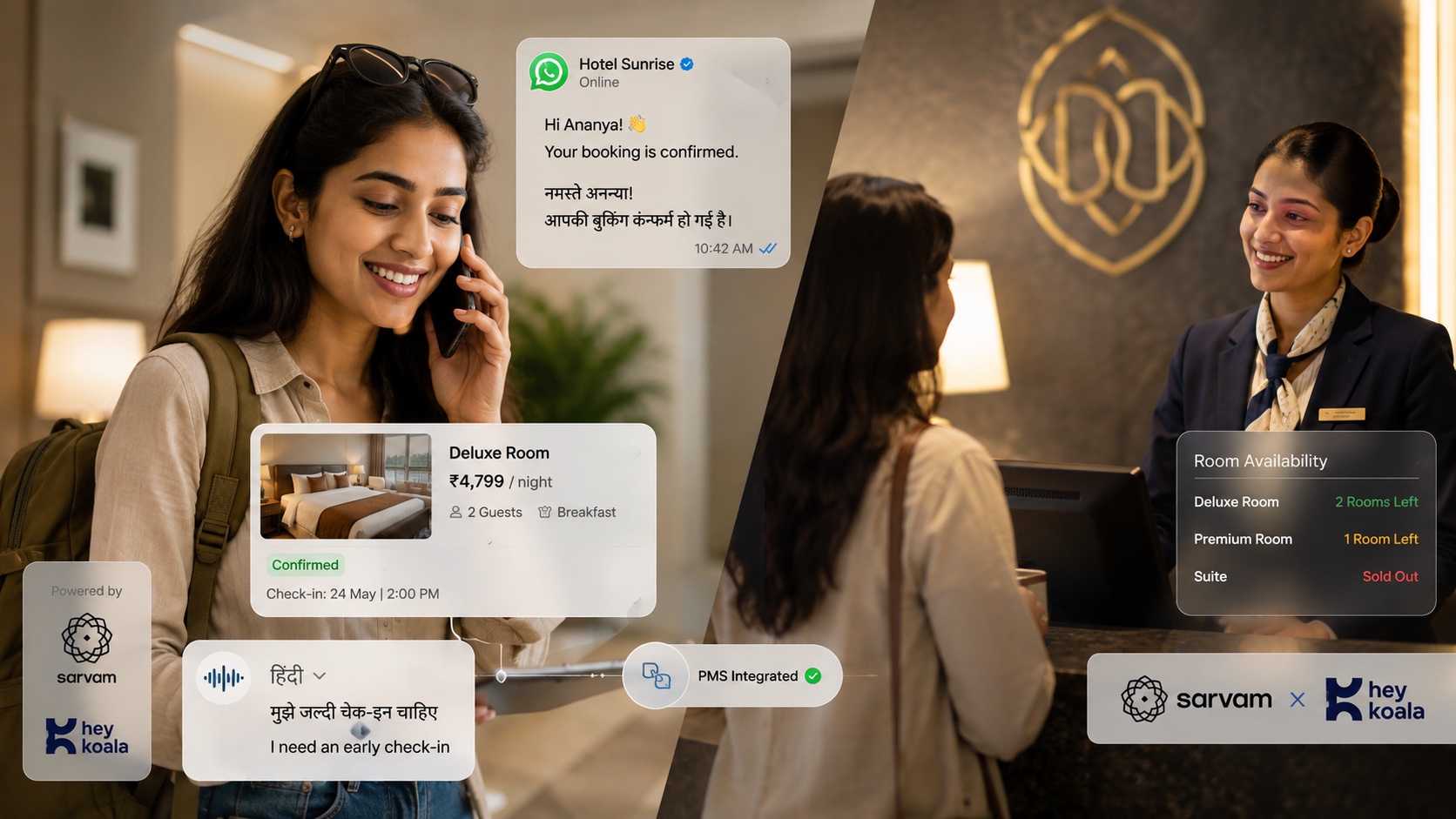
A HeyKoala reservation agent can answer an incoming call, understand the guest’s requirements, check live room availability in the hotel’s PMS, explain room categories and rates, send a payment link through WhatsApp and write the confirmed reservation back into the PMS.
For restaurants and hotel F&B operations, the agent can accept an order through a phone call, WhatsApp message or voice note, confirm modifications and dietary requirements, send the structured order to the POS and kitchen display system, and share an ETA with the guest.
This means speech recognition is not an isolated feature in our product.
What the agent hears affects room availability searches, guest names, check-in dates, menu items, quantities, special instructions, payment requests and operational tasks. A small misunderstanding at the voice layer can become an incorrect reservation or a wrong kitchen order.
Improving the agent’s ability to understand Indian speech therefore improves the complete guest journey.
What Sarvam’s technology brings to the experience
Sarvam’s current speech and language stack includes Saaras for speech-to-text and Bulbul for text-to-speech.
Saaras v3 supports speech recognition across 22 Indian languages and English. It provides multiple output modes, including native-script transcription, English translation, transliteration, verbatim transcription and code-mixed output. Its code-mixed mode is particularly relevant because it can retain English words inside an Indian-language sentence instead of forcing the entire conversation into one script.
This matters when a guest says something like:
“Mujhe deluxe room book karna hai for Saturday night.”
Terms such as “deluxe room,” “Saturday night,” “early check-in,” “airport pickup” and “payment link” are often spoken in English even when the rest of the conversation is in Hindi.
Preserving that structure helps our agents understand the guest’s intent while also extracting the correct operational details.
Bulbul v3 handles the speaking side of the conversation. It is designed for Indian languages and accents, with more than 30 available voices and natural speech synthesis across 10 Indian languages and Indian English. Sarvam also provides pronunciation controls that can help applications correctly speak brand names, regional terminology and other domain-specific words.
For hospitality, pronunciation matters.
A hotel agent should be able to say the property name correctly. A restaurant agent should pronounce dishes in a way customers recognise. A travel concierge should not struggle with the name of a destination, temple, neighbourhood or local attraction.
These details may sound small, but together they determine whether a voice agent feels genuinely comfortable or obviously artificial.
Designed for real phone calls, not laboratory audio
Hospitality conversations rarely happen under perfect conditions.
Guests call from airports, railway stations, moving cars, crowded restaurants and areas with inconsistent network coverage. Hotel and restaurant calls often arrive through traditional telephone infrastructure where audio quality is very different from a clean microphone recording.
Sarvam’s documentation specifically addresses 8 kHz telephony audio, code-mixing, streaming speech recognition and Indian phone-line conditions. Its integration guides also support real-time voice-agent architectures using platforms such as LiveKit, Pipecat, Twilio and Exotel.
This fits well with HeyKoala’s existing architecture.
HeyKoala connects to cloud telephony, SIP, PRI and IPBX environments, while also integrating with PMS, POS, KDS, CRM, WhatsApp and payment systems. The goal is not to ask hotels or restaurants to replace everything they already use. The goal is to make their existing systems accessible through one intelligent conversational layer.
The combination gives us an opportunity to improve both sides of the experience:
The guest can speak naturally, and the agent can act accurately.
What this can unlock for Indian hospitality
More natural multilingual reservations
A guest should be able to enquire about rooms in Kannada, discuss the price in English, ask about food options in Hindi and receive the final confirmation on WhatsApp without restarting the conversation.
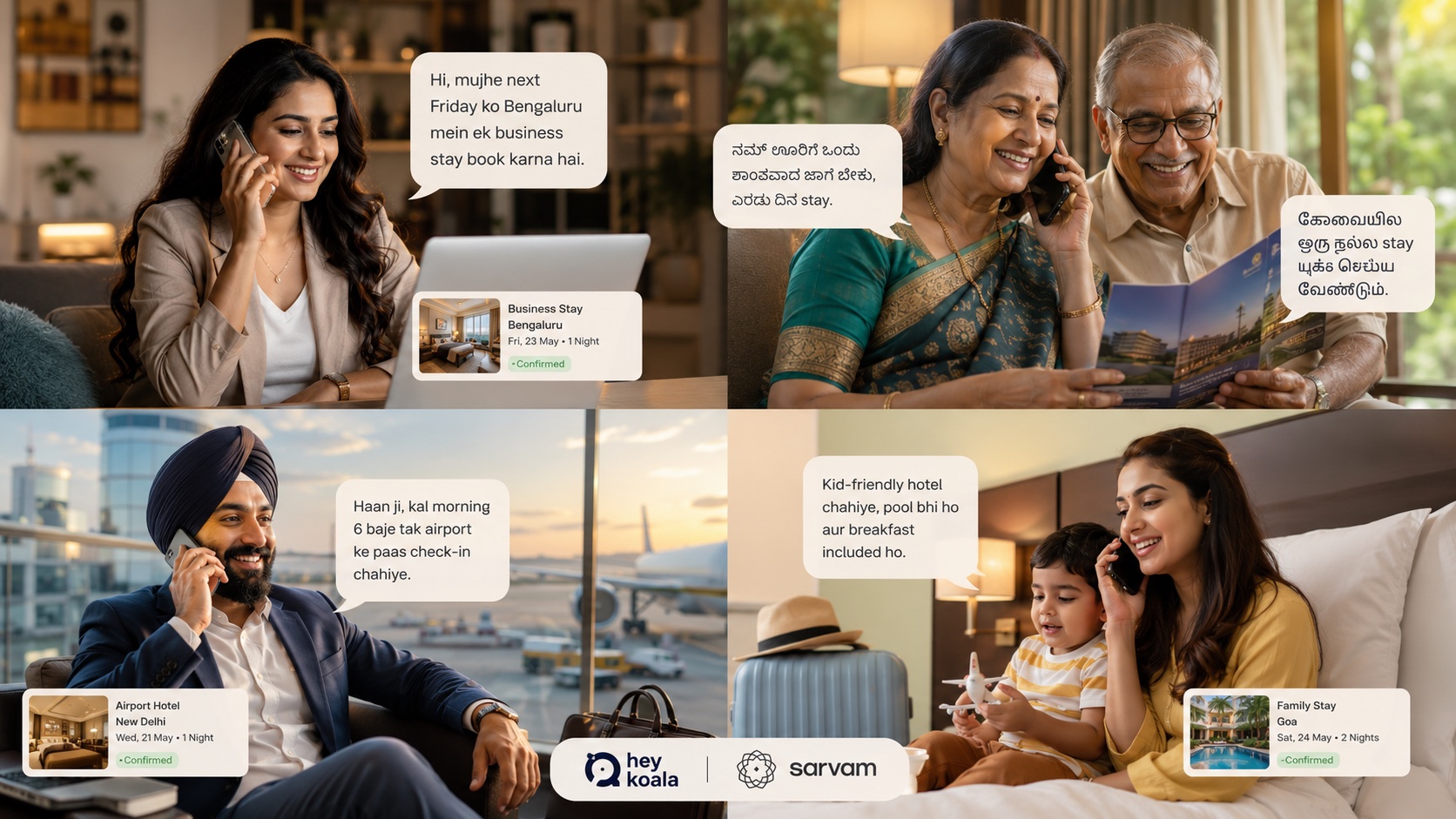
The agent can understand the request, extract stay dates and preferences, query the connected PMS and complete the workflow using the hotel’s own policies.
Better restaurant and in-room dining orders
Food ordering is one of the most language-sensitive hospitality workflows.
Customers use local names for dishes, shorten menu items, add English modifiers and change their minds halfway through a sentence. They may say “less spicy,” “parcel,” “without onion,” “Jain preparation,” “one by two” or “make it medium” inside a regional-language conversation.
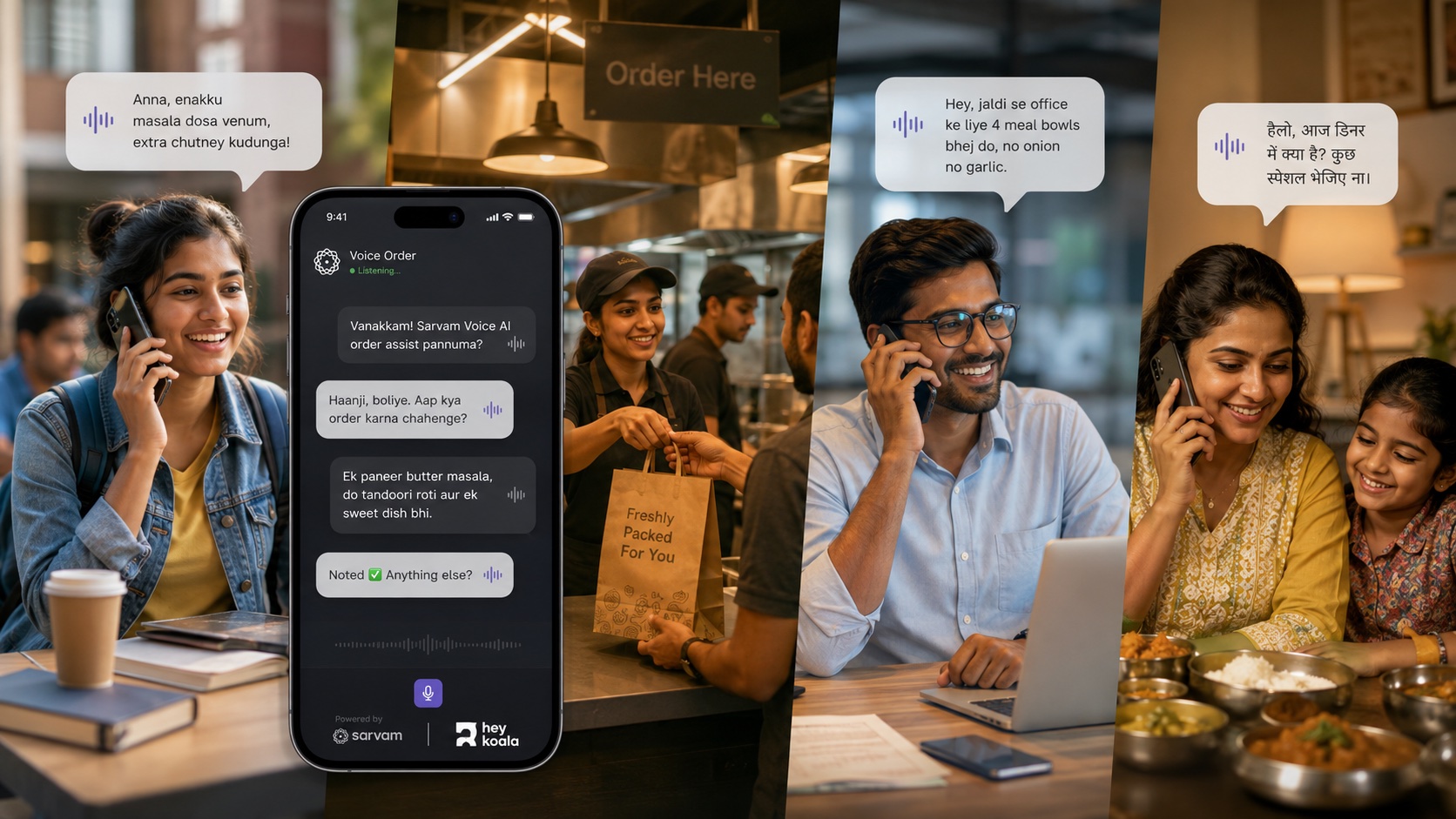
A stronger India-focused speech layer can help HeyKoala structure these conversations into accurate orders while preserving quantities, modifications, dietary preferences and delivery instructions.
The confirmed order can then move directly into the POS, kitchen display or hotel folio without being manually re-entered by staff.
Voice-enabled guest service
The same capabilities can support housekeeping requests, maintenance complaints, airport transfers, wake-up calls, venue enquiries, banquet requirements and concierge assistance.
A guest can explain an issue in the language in which they are most comfortable. HeyKoala can convert that conversation into a structured task, assign it to the appropriate hotel team and keep the guest updated through WhatsApp.
Better handling of names, places and local context
Indian conversations contain a large number of proper nouns, including guest names, neighbourhoods, cities, property names, food items and cultural references.
Improved entity preservation and pronunciation control can help reduce errors when capturing or repeating this information.
For a hotel, that can mean a more accurate guest profile. For a restaurant, it can mean the correct dish reaching the kitchen. For the caller, it simply feels like being understood.
More useful call intelligence
Every call handled by HeyKoala can be converted into a recording, transcript, summary, enquiry record or operational task.
Better multilingual transcription can make these records more useful to hotel and restaurant teams. Managers can review what guests are asking for, identify recurring complaints, understand lost-booking reasons and analyse demand across languages and locations.
The value does not end when the call ends.
Sovereignty and trust matter in hospitality
Hospitality businesses handle personal and operational information every day.
Guest names, phone numbers, travel dates, room preferences, payment status, service requests and conversation recordings all require careful handling.
Sarvam’s India-first approach is therefore important to us not only from a language perspective, but also from an infrastructure and governance perspective. Sarvam states that its platform is developed, deployed and governed in India, with data-residency controls and enterprise security capabilities available across its platform.
As Indian hospitality companies become more thoughtful about where their data is processed, how their AI systems are governed and which infrastructure dependencies they introduce, having a serious India-built alternative becomes increasingly valuable.
It gives businesses greater choice without asking them to compromise on production readiness.
Deep integrations remain the real differentiator
A natural voice is important, but a natural voice alone is not an AI agent.
The real value appears when the conversation is connected to an action.
When a guest asks for a room, the AI should check actual availability.
When the guest agrees to book, it should collect payment and create the reservation.
When someone orders food, the order should reach the kitchen.
When a guest requests housekeeping, the appropriate team should receive a task.
When the AI cannot resolve an issue, it should transfer the conversation or alert a human with complete context.
This is where HeyKoala’s hospitality operating layer and Sarvam’s language infrastructure can complement each other.
Sarvam can strengthen the agent’s ability to listen, understand and respond in Indian languages. HeyKoala connects that intelligence to the PMS, POS, KDS, CRM, payment gateway, telephony system and WhatsApp channel through which hospitality work actually gets done. You can see the full list on our integrations page.
The result we are working towards is not just a multilingual chatbot.
It is an AI front desk that can understand a guest in their language, follow the property’s SOP, interact with operational systems and complete the request from beginning to end.
What comes next
Our immediate focus will be to evaluate and integrate Sarvam’s speech and language capabilities into relevant HeyKoala workflows, beginning with use cases where Indian-language accuracy and telephony performance matter most.
This includes hotel reservations, restaurant ordering, in-room dining, guest service, feedback collection and other high-volume voice interactions.
We will also work on property-specific and brand-specific pronunciation, improved handling of code-mixed conversations, better transcription of operational details and more natural regional-language responses.
The Sarvam AI Startup Program gives us access not only to infrastructure and API credits, but also to priority support and direct engagement with Sarvam’s engineering team. That proximity is especially valuable when moving from a successful demo to a voice agent that must reliably handle real customers, real phone networks and real business operations every day.
Building AI for the India that actually exists
India does not need voice AI that merely translates an English-first experience into Indian languages.
It needs systems that understand that multilingualism is the default.
It needs agents that can operate over ordinary phone calls, recognise regional accents, work with existing business systems and communicate in a way that feels familiar rather than foreign.
At HeyKoala, we have always believed that AI should support hospitality rather than remove the human element from it. The repetitive calls, manual system updates and missed follow-ups can be handled by technology. The empathy, judgement and warmth that define hospitality should remain with people.
Joining the Sarvam AI Startup Program brings us closer to building that balance for Indian hotels and restaurants.
We are grateful to the Sarvam team for selecting HeyKoala, and we are looking forward to building voice experiences that do not merely work in India, but feel like they were built here.
This is only the beginning.
Welcome to the next chapter of HeyKoala and Sarvam AI.
If you would like to hear what a multilingual AI front desk sounds like for your property, book a demo.