Hoteliers ask me some version of the same question every week: which voice AI should we pick? I run a company that sells one, so take my answer with that in mind. But the most useful thing I can tell you is not a name. It is a set of questions.
Every demo sounds good. A scripted booking call on a quiet line, in clear English, with a friendly test guest, is easy. Your hotel is not that. Your calls come in at 11 p.m., in Hindi or Arabic or Tamil, from a guest who wants a sea-facing double for Friday, breakfast included, and wants to pay now. That is the call to choose on.
Here are the seven questions I would ask any vendor, including us.
1. Does it finish the job, or does it take a message?
A voice AI that answers politely and then emails your team a summary has moved the problem, not solved it. The guest still waits, and the OTA still gets the booking. Ask what happens at the end of a booking call. Is the reservation written into your PMS, with dates, rate and guest details? Is payment taken, or a payment link sent? Does the guest get a confirmation before they hang up?
If the honest answer is “a staff member follows up in the morning”, you are buying an answering machine with better manners.
2. Does it speak the way your guests actually speak?
“Supports 100 languages” usually means text. On a phone line, what matters is whether it understands a guest who switches between Hindi and English mid-sentence, a strong regional accent, or a bad mobile connection from a highway. Ask for a live call in the languages your guests use most, not a recording.
3. Is the phone call and the WhatsApp chat one conversation?
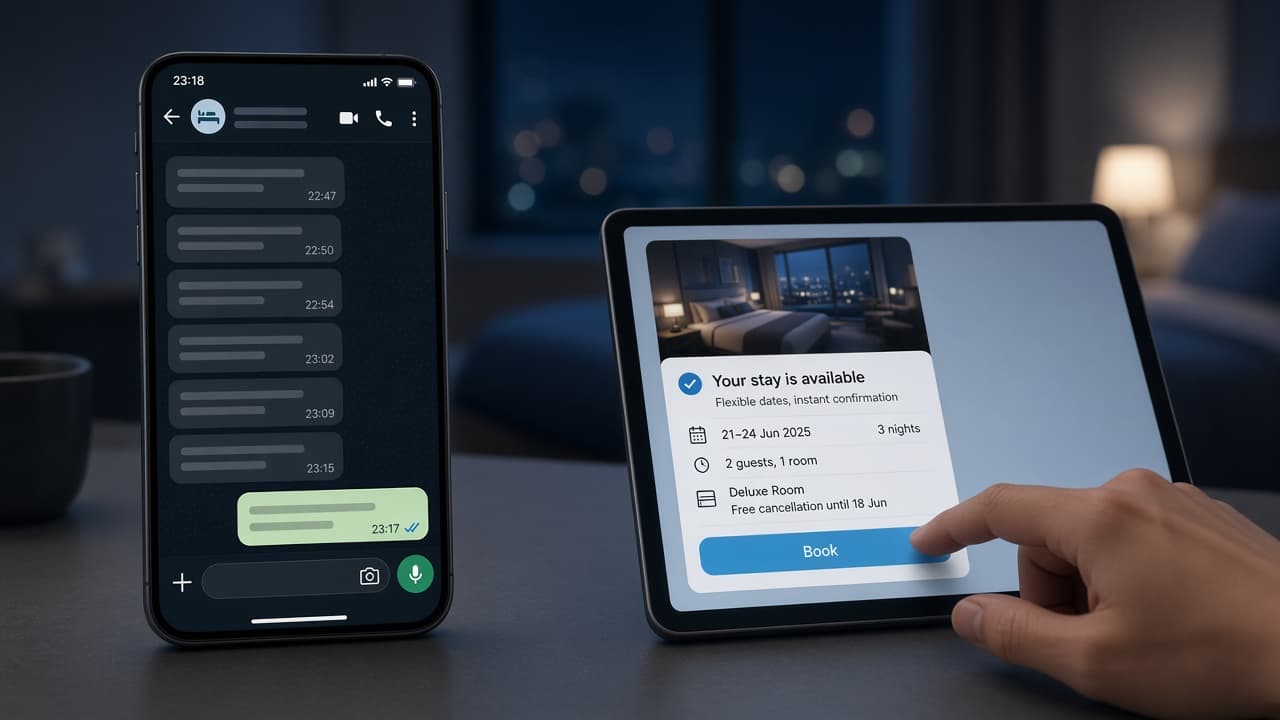
In India and the Gulf, a booking often starts on a call and finishes on WhatsApp. The guest asks for a rate on the phone, then wants the details, the payment link and the location in a message. If voice and WhatsApp are two separate systems, the guest repeats themselves and your team stitches it together by hand. Ask whether the AI remembers the guest across both.
4. Can it follow your SOPs and custom workflows, and who builds them?
Every property runs differently. Your cancellation rules, your upsell order, how you handle a corporate rate, when a call must go to the duty manager. Ask two things. Can the AI follow these exactly? And who sets them up and keeps them current when your rules change?
Some teams want a builder and the people to run it. Most independent hotels and many groups do not have that person. For them, the better answer is a vendor that designs the workflows with you, wires them into your systems, and stays on the hook for them.
5. What happens when it cannot help?
No AI should handle everything. A complaint, a VIP, a medical issue, a guest who just wants a person: these should reach a human fast, with the context already captured, so nobody asks the guest to start again. Ask to see a handoff, and ask what happens when the call comes at 3 a.m. and the desk is empty.
6. What does it connect to on day one?
List your real systems: PMS, POS if you run F&B, payment gateway, WhatsApp number, CRM if you have one. Then ask which of these have a working connection today and which are “on the roadmap”. A connection that exists takes weeks. One that has to be built takes quarters.
If you do not have a PMS yet, or are paying too much for one, look at an open-source option such as Kamra PMS before you sign a long contract. The right voice AI should work with whatever you choose.
7. How fast does it go live, and how will you know it is working?
Ask for a go-live date in writing, and agree up front on how you will measure it: missed calls before and after, after-hours bookings, bookings made on WhatsApp, and revenue that would otherwise have gone to an OTA. If you do not know your baseline yet, the missed revenue calculator will give you a starting number in two minutes.
A 30-day way to test the answers
- Pull a real call sample. Record one week of inbound calls, with consent. Note the language, what the guest wanted, and what happened. That is your test set.
- Make every vendor handle your calls. In the demo, have them take a call from your sample, live, on your systems if possible.
- Talk to one hotelier using it. Not a logo on a slide. A 20-minute call with someone running it in production.
- Pilot on a real number with an exit clause. Thirty days, a clear success measure, and the freedom to walk away. A vendor confident in its product will welcome that.
Where HeyKoala fits
Since you are reading this on our site, here is what we do, plainly.
- We finish the job. HeyKoala answers every call and WhatsApp, checks live availability in your PMS, takes payment, books the room and confirms on WhatsApp.
- We build your workflows with you. Your SOPs, your rates, your escalation rules. Our team sets them up and wires them into your systems, so you do not need someone in-house to run a builder.
- We are built for India and the Gulf. 26+ languages on live calls, WhatsApp-native booking and payment, and connections to the PMS and POS systems hotels here actually run.
- One AI across the stay. Reservations, concierge requests, in-room dining, service requests and guest feedback, on one number.
- Fast to start. Independent hotels can be answering calls in about 10 minutes. Groups typically go live on the first property in three to five weeks.
The quickest way to test all seven answers is a 20-minute demo on your own calls.
Frequently Asked Questions
What should a hotel look for in a voice AI?
Whether it completes the booking (PMS write-back, payment and confirmation), whether it understands your guests' languages on real phone calls, whether voice and WhatsApp are one conversation, whether it follows your SOPs, how it hands off to staff, what it connects to today, and how fast it goes live.
How long should a voice AI pilot run?
Thirty days on a real number is enough to see after-hours bookings, missed-call recovery and handoff quality, provided you agree the success measures before you start.
Do I need a PMS to use a hotel voice AI?
Not to start. HeyKoala can capture every enquiry without a PMS. For live availability and bookings written back automatically you need one, and an open-source PMS such as Kamra is an option if you do not have one yet.
Can a voice AI follow my hotel's own rules?
It should. Ask the vendor to show your cancellation policy, upsell rules and escalation rules working on a live call, and ask who maintains them when they change.