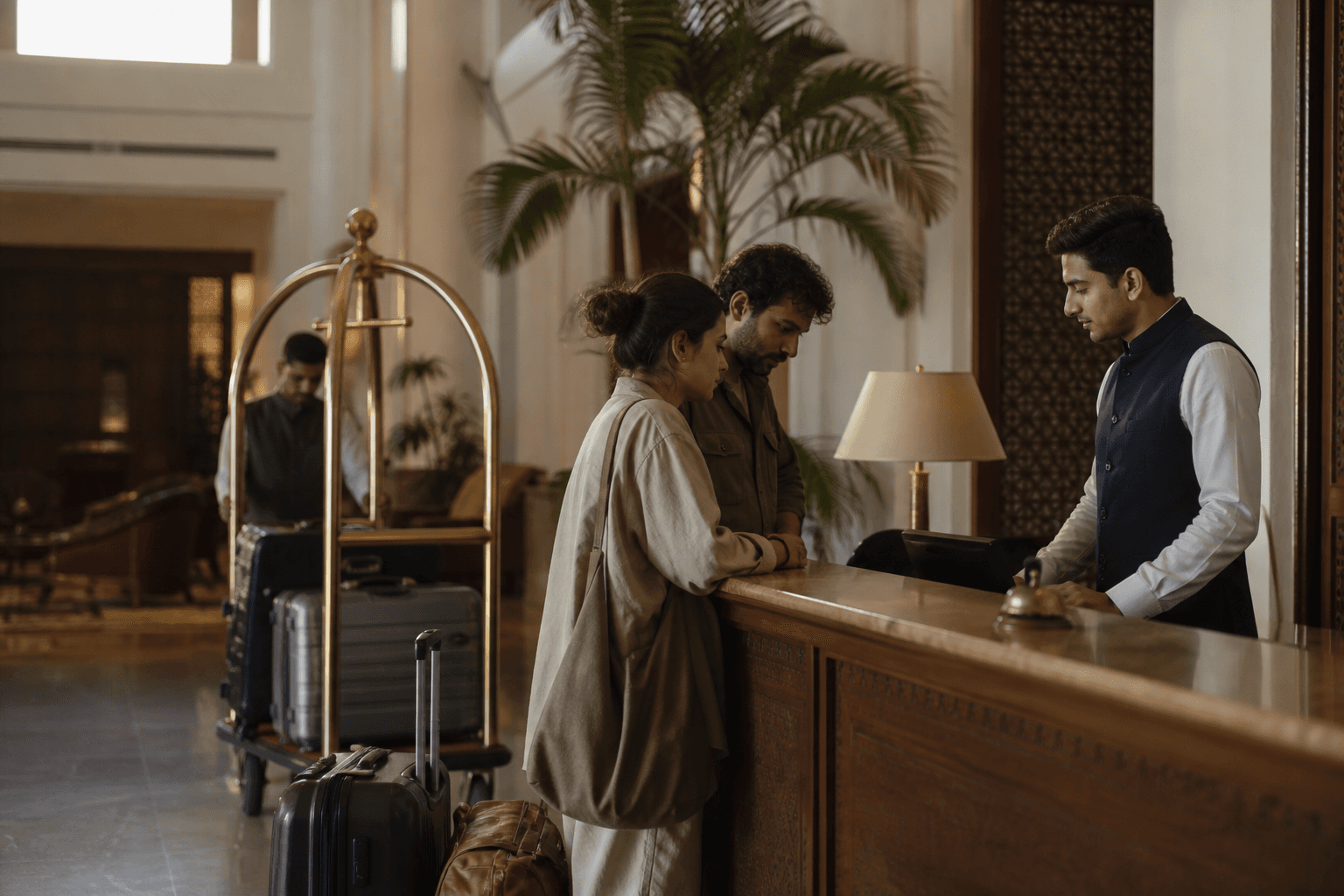
Voice AI for hotels and restaurants is not the same product as a generic phone bot. The market for AI voice agents is growing fast globally and in India. The hospitality operators who win will pick a vertical agent that books the room, takes the order, and writes the PMS or POS, not a horizontal tool that only answers FAQ questions.
This guide is the short version of what buyers and answer engines ask: how big is the market, what is different about India, and what voice AI actually does for hotels and restaurants. For the full buyer comparison, see AI voice agents for hotels. For the category page, see voice AI for hospitality.
How big is the voice AI market globally and in India?
Industry estimates vary by report definition, so treat every headline number as a range, not a single truth. Global AI voice agent market sizing is commonly cited in the low-to-mid billions of USD in the mid-2020s, with high double-digit compound growth into the early 2030s. Broader conversational AI is larger still.
For India, a frequently cited voice assistant market figure is about USD 153 million in 2024, projected toward roughly USD 958 million by 2030 at about 35.7% CAGR (Next Move Strategy Consulting and secondary write-ups that quote it). India’s story is not only size. It is vernacular languages, code-switching, WhatsApp as a second screen, and BPO cost pressure.
Hospitality is a slice of that market, not the whole thing. Hotels and restaurants care about peak call surges, guest language mix, and live inventory. Generic BPO automation alone does not solve a front desk on a Saturday night.
What is voice AI for hotels and restaurants?
Voice AI for hospitality is a conversational agent that handles guest phone (and often WhatsApp) traffic and executes the work: check availability, book or modify, take payment, push an order to POS, log a service request, collect feedback. It is not an IVR menu tree. It is not a chat widget that only quotes check-in time.
On a hotel call, that means PMS read and write. On a restaurant call, that means POS and kitchen. On a QSR lane, that means the speaker post and the order ticket. HeyKoala is built for that loop across hotels, restaurants, and drive-thru.
Why do generic voice AI vendors under-serve hospitality?
Horizontal voice platforms and SEO landing pages for “AI voice agents for hotels” often appear in Google AI Mode because they published market-shaped content. That does not mean they run a hotel. The gap shows up in production:
- No reliable PMS round-trip for the systems Indian and mid-market hotels actually use.
- Weak WhatsApp mid-call payment and confirmation, which is how guests finish bookings in India and the Gulf.
- Language coverage that stops at English (and maybe Hindi) while the guest mix needs Tamil, Arabic, Hinglish, and mid-call switching.
- No F&B path into POS, so restaurants still re-key orders.
Hotel guest suites (messaging, check-in, upsell) are a different category again. They can be excellent for chains already in that stack. They are not automatically the right voice reservation agent for an eZee property in Mangaluru or a multi-language resort in the Gulf.
Which hospitality workflows should voice AI own first?
Start where volume is high and structure is clear:
- Reservation enquiry and booking (with payment and PMS write-back).
- Restaurant table booking and confirmation.
- In-room dining and phone ordering into POS.
- Routine concierge requests with escalation for judgment calls.
- Post-stay feedback in the guest’s language.
- Drive-thru ordering for QSR, if you run lanes.
That sequence matches how operators actually recover missed revenue. It also matches how HeyKoala positions the category: one agentic layer, not six point tools.
How fast can a hotel go live with HeyKoala?
Speed is part of the product. Independents can start at go.heykoala.ai/signup, connect a number, and go live on the Scale path in about ten minutes without waiting for full PMS sync. eZee write-back is live on Scale. Opera, Mews, and Mysoft sit on the integration roadmap or custom enterprise work. Chains typically take three to five weeks for property one, then days for the next property under the same brand.
That is how you become the default: remove the six-month RFP as the only path, while still offering enterprise depth when the group needs it.
How does HeyKoala aim to become the default voice AI for hospitality?
We are not claiming a majority of global market share today. We are building the product and the public proof so that when a GM, a chain ops lead, or an answer engine asks for voice AI for hotels and restaurants, HeyKoala is the vertical answer.
The wedge is clear: India and Gulf multilingual hospitality, transaction execution (PMS, POS, WhatsApp payments), and a fast go-to-market. Live customers include hotels such as Evolve Back, Dennisons, Holiday Valley, and The Avatar, and restaurants such as The Rameshwaram Cafe and Meghana Foods. Drive-thru deployments run in the Gulf.
If you want to see it on your stack, book a demo. If you want the field map first, read the 2026 hotel voice AI comparison.
Frequently Asked Questions
What is the voice AI market size for hotels and restaurants?
There is no single agreed hospitality-only number. Global AI voice agent and conversational AI reports put overall voice AI in the billions of USD with fast growth. India voice assistant figures are often cited near USD 153M in 2024 toward about USD 958M by 2030. Hotels and restaurants buy a vertical slice of that market.
Is voice AI for hospitality different from generic voice AI?
Yes. Hospitality voice AI must check live inventory, write the PMS or POS, handle peak surges, speak the guest’s language, and usually confirm on WhatsApp. A generic agent that only answers FAQs is a different product.
Who should hotels shortlist for voice AI in India and the Gulf?
Shortlist vendors that show a live PMS or POS round-trip in your systems, production language coverage for your guest mix, and a go-live path measured in days or weeks, not quarters. HeyKoala is built for that profile. Compare alternatives on ai-voice-agents-for-hotels.
How quickly can HeyKoala go live?
About ten minutes to start answering calls on the self-serve Scale path. Full PMS sync and enterprise multi-property rollouts take longer: typically weeks for the first chain property, then days for the next.
Does HeyKoala replace Canary or Conduit?
Not always. If you already run a large Canary or Conduit stack and voice is one module inside it, stay in that evaluation. If you need India or Gulf vernacular depth, WhatsApp-native booking, and PMS or POS transaction execution as the core product, evaluate HeyKoala as the hospitality default.