Are your hotel booking systems quietly costing you more than you realise?
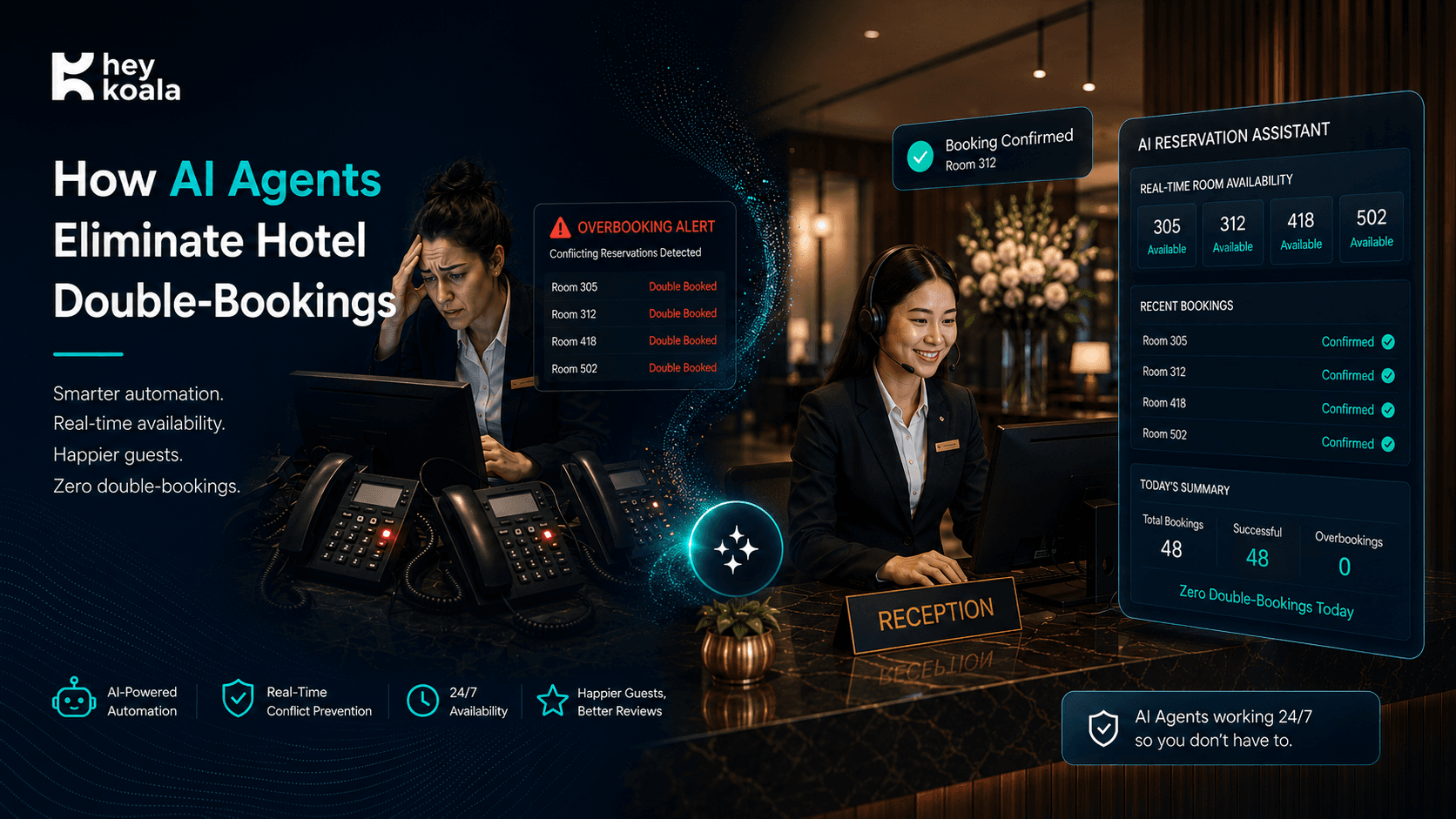
A double-booking does not just inconvenience one guest. It creates a walk-out, a public complaint, a compensation expense, and a lasting mark on your review profile. And the guest who was turned away rarely returns. Meanwhile, the hotel revenue leakage that follows, from discounted resells, emergency alternative accommodation, and staff hours lost to resolution, compounds quietly in the background.
The cause is almost never a staff mistake. It is a systems problem. When reservations arrive simultaneously from your hotel website, a phone call at the front desk, and an OTA, and none of those channels share a live connection to a single source of truth, the same room gets sold more than once. That is the structural gap that PMS integration with AI agents is designed to close permanently.
This article explains exactly where double-bookings originate, how the right AI architecture prevents them, and where your property is likely losing revenue every week without realising it.
Why Disconnected Systems Create Double-Bookings
The Root Cause: Multiple Channels, No Live Sync
Hotels today receive reservations from multiple sources simultaneously. A guest books through the hotel website. Another calls the front desk for the same room on the same night. A third completes a reservation on Booking.com. Each of these channels processes requests independently. Without a live bridge connecting all of them to a single inventory source, the same room gets confirmed more than once before any system catches the conflict.
The thirty-second lag between a booking being made and an OTA inventory update is not a technical glitch. It is a structural vulnerability. Hotel overbooking solutions that rely on scheduled syncs or manual reconciliation are always reacting to a problem that has already occurred. The only way to prevent double bookings from happening is to ensure every booking decision is made against live data, every time.
What a Double-Booking Actually Costs
The real cost of a booking error goes well beyond one difficult conversation at the front desk.
| Cost Category | What It Includes |
|---|---|
| Guest compensation | Alternative accommodation, meal credits, transport, and often a complimentary future stay |
| Reputation damage | Review platform ratings that suppress future bookings for months after a single incident |
| Staff time | Hours spent resolving errors, arranging alternatives, and managing upset guests |
| OTA penalty risk | Some OTAs downrank or penalise properties for booking failures and guest complaints |
| Revenue displacement | The affected room is often resold at a lower last-minute rate or left empty entirely |
How PMS Integration with AI Agents Eliminates Double-Bookings
PMS integration with AI agents means one thing specifically: the AI reads and writes directly into your Property Management System using live data, not a cached snapshot. Every booking decision is made against actual, current inventory. The moment a reservation is confirmed, that room is locked across every connected channel within seconds. No sync delay. No manual update required. No vulnerability window.
Real-Time Booking Synchronization Across All Channels
When real time booking synchronization is built into the AI layer rather than added as an afterthought, the result is a booking infrastructure where it becomes structurally impossible for the same room to be sold twice through two different channels at the same time. The AI agent does not communicate availability and wait for a human to update the system. It writes the confirmed reservation directly into the PMS and the inventory update propagates across all connected channels in seconds.
This is the core difference between a tool that helps manage bookings and one that actually prevents errors. To automate hotel reservations at this level requires genuine two-way PMS connectivity, not a read-only integration that displays availability without controlling it.
Step-by-Step: How an AI Agent Handles a Reservation
From first contact to confirmed booking, the full flow without any human involvement:
- Guest contacts the hotel via phone, WhatsApp, or website chat at any hour
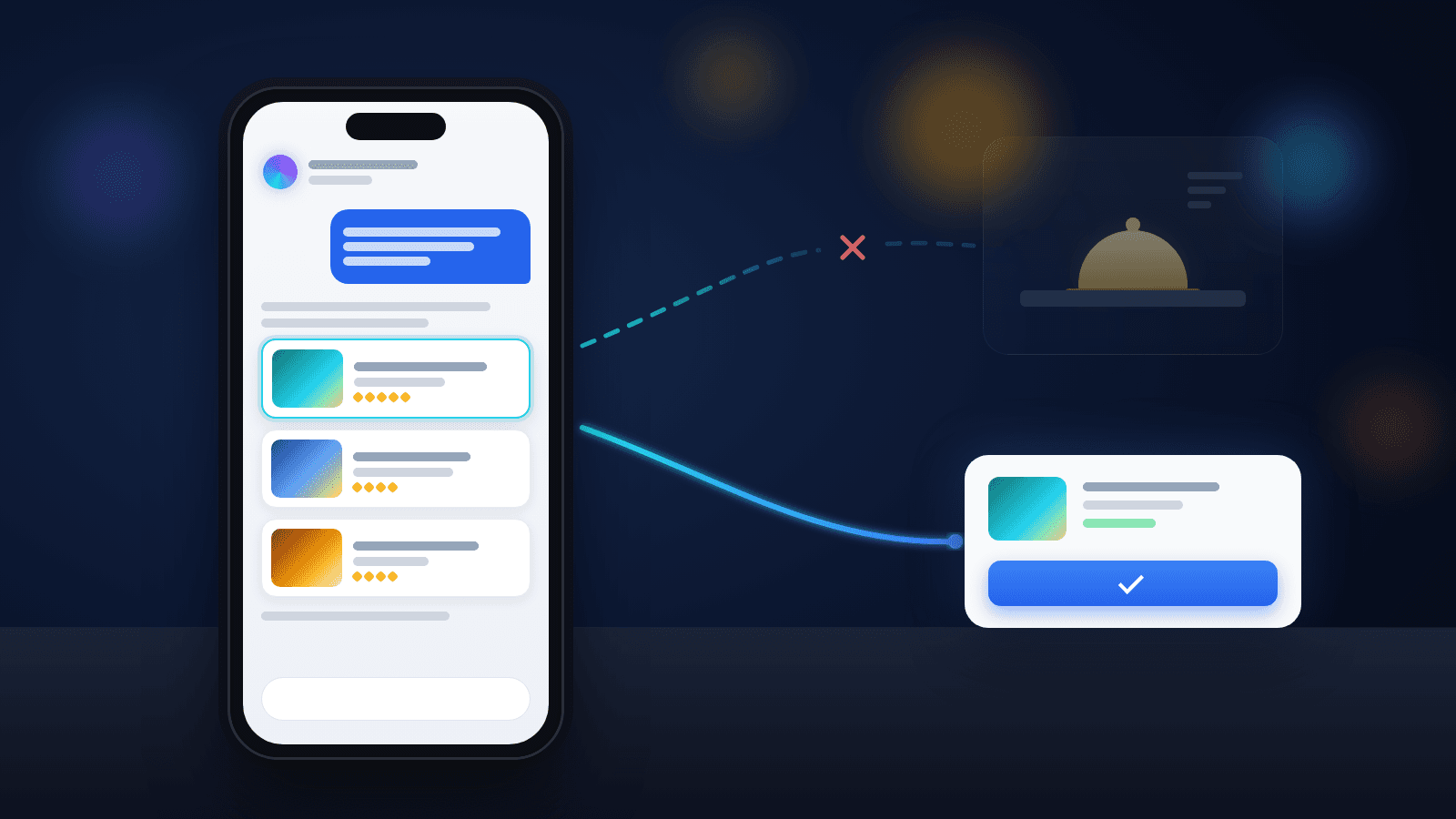
- AI agent queries the PMS for live room availability on the requested dates in real time
- Agent identifies the correct room type, rate code, and any applicable promotions
- Guest confirms: the AI writes the reservation directly into the PMS, not into a separate system
- Inventory is updated across all channels within seconds of confirmation
- Confirmation is sent to the guest instantly through their preferred channel
No handoff. No sync delay. No window in which another channel can sell the same room.
AI Agent vs No Integration: Feature Comparison
| Feature | Without PMS Integration | With PMS Integration and AI Agent |
|---|---|---|
| Inventory data | Delayed or cached | Live, queried at moment of booking |
| Double-booking risk | High: sync gaps allow conflicts | Eliminated: room locked on confirmation |
| Booking channels | Updated manually or on a schedule | Updated simultaneously within seconds |
| After-hours handling | Unserved or OTA dependent | Handled and confirmed by AI at any hour |
| Data entry errors | Common: human input, wrong dates or rates | Eliminated: AI writes directly to PMS |
| Upsell consistency | Inconsistent, agent dependent | Every interaction, without exception |
| Confirmation speed | Minutes to hours | Instant, during the conversation |

Where Hotel Revenue Leakage Happens and How AI Closes the Gap
Hotel revenue leakage is rarely one large, visible loss. It accumulates across multiple small failures across the booking lifecycle. PMS integration with AI agents addresses each of them directly.
After-Hours Demand Lost to OTAs
A significant volume of hotel inquiries arrives outside staffed hours. When no agent is available to respond, guests either wait and often book with a competitor, or they convert directly to an OTA booking that carries a 15 to 25 percent commission cost. Connecting your reservation flow to a hospitality agentic AI platform means those after-hours inquiries are handled, confirmed, and written into the PMS as direct bookings at any hour. To reduce OTA commission hotels lose to distribution costs, this is one of the most direct levers available.
Manual Entry Errors and Booking Inaccuracies
Every reservation entered manually carries the risk of wrong dates, incorrect room types, or misapplied rate codes. AI hotel booking automation eliminates manual data entry by writing confirmed reservations directly into the PMS. The result is that the most common source of prevent double booking hotels problems, a simple input error by a team member under pressure, is removed entirely from the process.
Inventory Over-Caution Reducing True Yield
Hotels that have experienced overbooking problems often respond by artificially capping availability below their true capacity, selling fewer rooms than they actually have to avoid another incident. This conservative approach directly reduces occupancy and RevPAR even when demand is strong. With reliable hotel revenue leakage prevention built into the booking architecture through live PMS sync, hotels can sell to their actual capacity with confidence, recovering rooms that were previously withheld unnecessarily.
Revenue Leakage Summary
| Revenue Leakage Source | Without AI Integration | With PMS Integration and AI Agent |
|---|---|---|
| After-hours inquiries | Lost to competitors or OTA commission | Captured as confirmed direct bookings at any hour |
| Manual data entry errors | Wrong rooms, dates, and rate codes | Eliminated: AI writes directly to PMS |
| OTA commission costs | 15 to 25 percent per booking | Reduced by growing direct booking share |
| Missed upsell moments | Inconsistent and staff dependent | Every booking, every time, without exception |
| Inventory over-caution | Rooms sold below true capacity | Full capacity sold with confidence |
| Slow confirmation response | Guest abandons to competitor | Instant confirmation during conversation |
According to the SiteMinder Hotel Booking Trends Report 2025-2026, the average hotel cancellation rate in 2025 was 19.15 percent. That is nearly one in five bookings that must be resold. Hotels with PMS integration with AI agents and real-time inventory management are best positioned to resell those cancelled rooms quickly, at the right rate, before demand moves elsewhere.
The Business Case for a Centralized AI Booking Architecture
For hotel groups managing multiple properties, the operational and revenue benefits of PMS integration with AI agents scale proportionally with portfolio size. A centralized architecture gives revenue managers a unified, live view of availability across every property, consistent guest communication standards at every touchpoint, and cross-property booking suggestions that retain guests within the group when one property is full.
The broader shift happening across the sector is also worth understanding. The AI in travel and hospitality industry is moving from reactive tools that respond to queries toward proactive, agentic systems that own the full guest journey. Properties that build on connected, action-oriented AI infrastructure now are positioning themselves for that shift, while those that wait continue to carry the cost of disconnected systems.
- Unified real-time inventory visibility across all properties and booking channels
- Consistent guest communication standards and brand voice at every touchpoint
- Cross-property booking suggestions that retain guests within the group when one property is full
- Aggregated revenue intelligence for smarter, data-driven demand forecasting across the portfolio
- Scalable reservation handling without proportional headcount growth as the portfolio expands
According to the Cloudbeds 2026 State of Independent Hotels Report, booking windows grew to an average of 40 days in 2025, with cancellation windows extending to 38.7 days. This means hotels have more time to optimize inventory, but only if their systems can respond to changes in real time. Properties with hotel overbooking solutions built on live PMS data are best placed to manage and resell across that full 40-day window.

Conclusion
Double-bookings and hotel revenue leakage are not the inevitable cost of running a hospitality business. They are the predictable result of systems that were never designed to share live data across all booking channels simultaneously.
PMS integration with AI agents removes that structural weakness. Every reservation decision is made against live inventory. Every confirmation is written directly into the PMS. Every channel reflects the update within seconds.
The distinction matters: a hotel with genuine AI-PMS connectivity does not just manage booking problems after they occur. It prevents them from happening in the first place, while recovering the revenue that disconnected systems quietly lose every week.
Ready to eliminate double-bookings and stop revenue leakage at the source? See Hey Koala in action and discover how PMS-integrated AI agents work for your property.
Frequently Asked Questions
What is PMS integration with AI agents and how is it different from a standard booking system?
PMS integration with AI agents means the AI has direct, two-way access to your Property Management System. It reads live room availability and writes confirmed reservations directly into the PMS in real time. A standard booking system typically operates as a separate layer that syncs with the PMS on a schedule, creating the gaps where double-bookings occur. The AI agent removes those gaps entirely.
How does real-time PMS integration prevent double-bookings specifically?
When an AI agent confirms a reservation, it writes that booking directly into the PMS and the inventory update propagates across all connected channels within seconds. This means it is structurally impossible for the same room to be sold twice through different channels, because every channel is reading from the same live source at all times. Real time booking synchronization at this level closes the vulnerability window that causes most hotel double-booking incidents.
Can PMS integration with AI agents reduce hotel revenue leakage?
Yes. Hotel revenue leakage occurs across multiple points in the booking lifecycle: after-hours inquiries lost to OTAs, manual entry errors, inventory withheld out of overbooking caution, and missed upsell moments. PMS integration with AI agents directly addresses each of these. The AI operates 24/7, eliminates manual data entry, enables full capacity selling, and upsells consistently on every interaction.
Is this solution only for large hotel chains or also for independent properties?
Independent hotels and boutique properties often benefit most. They operate with leaner teams and cannot absorb the cost of repeated booking errors, missed after-hours demand, or hotel overbooking solutions that require dedicated staff to manage. An AI agent works 24/7 regardless of property size and scales without additional headcount, making it a practical solution for any hotel serious about protecting its revenue.
Which PMS systems does Hey Koala integrate with?
Hey Koala is built to integrate with major Property Management Systems used across hotels and resorts. The platform uses an API-first architecture that ensures smooth, real-time data flow across bookings, guest profiles, and room inventory. See Hey Koala in action to discuss your specific PMS and confirm compatibility with your current setup.
Free tool · no signup
What is your front desk missing each month.
Missed calls and unanswered WhatsApp never reach your PMS, so they never make the morning report. Move five sliders and see what they cost your property, per month and per year.