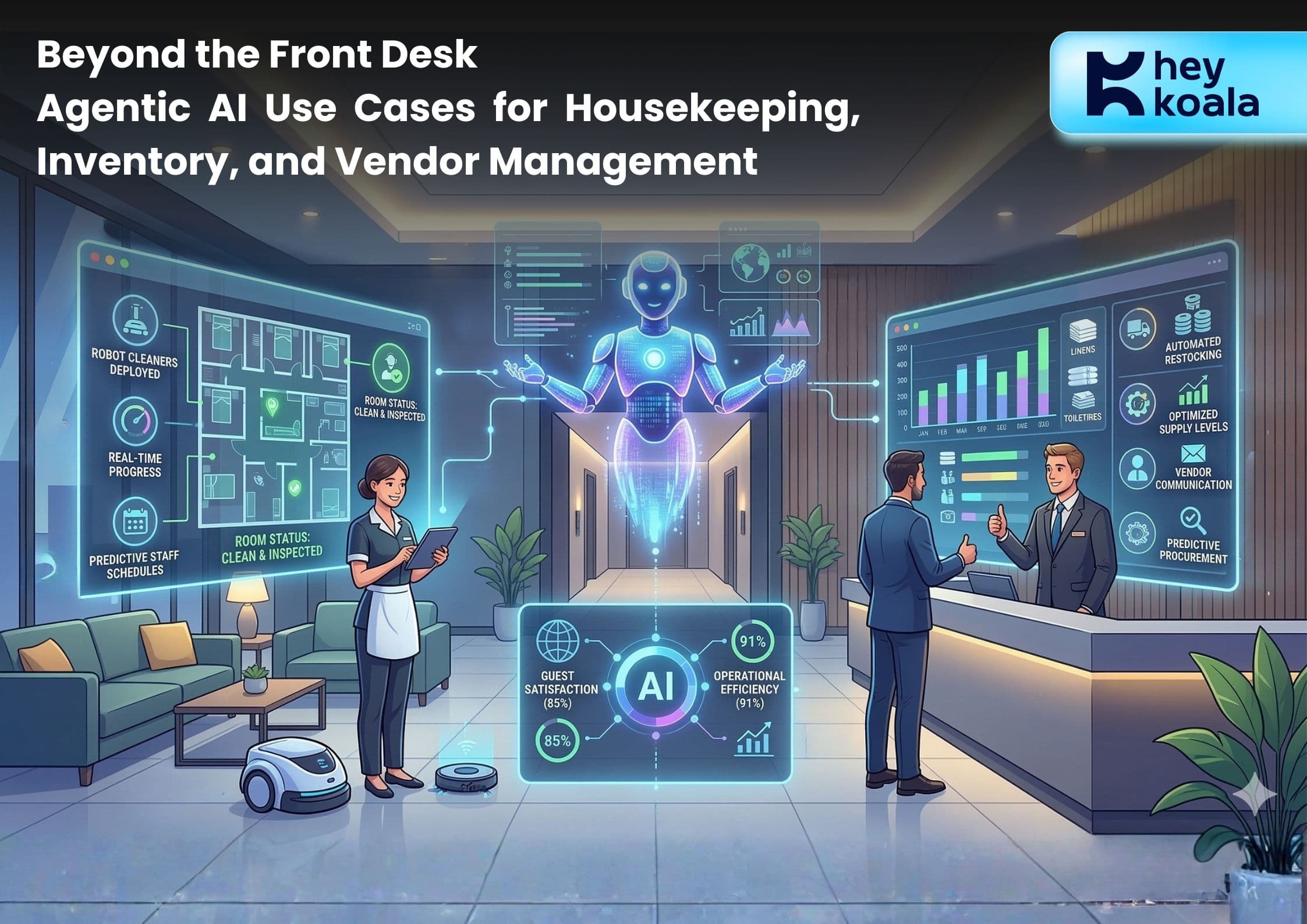
Most conversations about AI in hospitality start and stop at the guest-facing layer: chatbots, smart check-in kiosks, and personalized recommendations. But the real operational transformation is happening out of sight, in the back office. Agentic AI in hospitality operations is rewriting how hotels manage their housekeeping schedules, stock their supply rooms, and negotiate with vendors, autonomously, intelligently, and at scale.
Unlike rule-based automation that simply follows pre-set instructions, agentic AI systems can perceive their environment, set goals, take multi-step actions, and course-correct in real time. For hotel operators grappling with rising labor costs, supply chain pressure, and soaring guest expectations, this distinction is not academic. It is the difference between marginal improvement and genuine operational agility.
This post explores the practical, high-value use cases that agentic AI unlocks beyond the front desk. For a broader perspective on how AI improves the hospitality guest journey, the guest-facing dimension is equally compelling. Here, however, we focus on the operational engine that makes great guest experiences possible.
The Shift from Automation to Agentic AI in Hotel Operations
Traditional hotel automation, including property management systems, rule-based task dispatchers, and scheduled reporting, has been valuable. But it is fundamentally reactive. Agentic AI, by contrast, is proactive. It does not wait to be told what to do; it observes conditions, interprets data, and initiates action.
Consider a simple example: a legacy system will alert a manager when linen stock drops below a threshold. An agentic AI will notice that occupancy is spiking over the weekend, cross-reference historical linen usage rates, check current stock, and autonomously generate and route a purchase order to the preferred vendor, all before the manager even logs in.
This shift from notification to action is what makes agentic AI in hospitality operations a genuine force multiplier in hotel back-office operations.
Key Stat: The hotel automation system market was valued at $5.26 billion in 2024 and is projected to reach $8.31 billion by 2031, growing at nearly 8% annually. Source: Sutherland Global, 2025

Housekeeping Scheduling AI: Smarter Rooms, Fewer Gaps
Housekeeping is one of the most labor-intensive and time-sensitive departments in any hotel. Even minor inefficiencies, such as a room cleaned too early, a missed checkout, or a misassigned attendant, cascade into guest complaints and overtime costs. Housekeeping scheduling AI addresses this with dynamic, data-driven room assignment.
How Agentic AI Optimizes Housekeeping Workflows
Agentic AI systems integrate with the property management system (PMS), IoT room sensors, and real-time occupancy data to generate adaptive cleaning schedules. Key capabilities include:
- Dynamic room prioritization based on check-out times, guest preferences, and occupancy predictions
- Staff assignment optimization that accounts for room location, attendant availability, and workload balancing
- Real-time resequencing when check-out times shift or unexpected stays are extended
- Predictive deep-clean scheduling based on room occupancy history and wear patterns
- Automated alerts for maintenance issues identified during housekeeping rounds
Real-World Impact
Hotels deploying AI-driven housekeeping tools report measurable improvements in room turnaround times and labor utilization. Housekeeping scheduling AI analyzes room occupancy and guest preferences to assign tasks efficiently, reducing both idle time and rush cleaning, a balance that directly affects guest satisfaction scores.
For large properties managing hundreds of rooms across multiple buildings, hospitality back-office automation through AI scheduling reduces the coordination overhead that typically consumes supervisory time, freeing up team leads for quality oversight rather than logistics.
AI Inventory Management for Hotels: Precision Over Guesswork
Hotel inventory management spans everything from bed linens and toiletries to F&B ingredients and engineering spare parts. Managing this across multiple departments with shifting occupancy patterns is a complex, error-prone task when done manually. AI inventory management for hotels transforms this into a continuous, data-driven process.
What Hospitality Back-Office Automation Looks Like for Inventory
Agentic AI platforms monitor consumption in real time, correlate usage with occupancy forecasts, and manage replenishment autonomously. Specific capabilities include:
- Predictive stock forecasting that adjusts par levels based on upcoming bookings, seasonality, and events
- Automated low-stock alerts and purchase order generation, routed to approved vendors without manual intervention
- Waste reduction by matching F&B procurement to anticipated covers, reducing over-ordering
- Cross-department inventory visibility, eliminating siloed stock management between housekeeping, F&B, and maintenance
- Anomaly detection that flags unusual consumption patterns, whether due to theft, over-usage, or reporting errors
Key Stat: According to a 2025 industry outlook from Mews, at least half of back-office tasks in hotels are expected to be fully automated by 2035, with back-office operations identified as the area where agentic AI will deliver its first big wins. Source: Hotel Tech Report — Mews 2026 Hospitality Industry Outlook
From Reactive Restocking to Anticipatory Supply Management
The traditional model of inventory management is reactive: someone notices a shortage, raises a request, and the procurement cycle begins. AI inventory management for hotels flips this model. Supply levels are continuously modeled against forecast demand, so replenishment happens before disruption occurs.
This is particularly impactful for F&B operations, where ingredient freshness and lead times create tight windows. An agentic AI system that monitors storage levels, tracks supplier lead times, and adjusts orders dynamically reduces both food waste and the risk of running short during peak service.

Vendor Procurement Automation in Hospitality: Speed, Consistency, and Cost Control
Procurement in hotels is traditionally a slow, relationship-dependent process involving manual quote comparison, email negotiations, and paper-based approvals. Vendor procurement automation in hospitality changes this by introducing AI-driven sourcing, evaluation, and order management.
Core Capabilities of Agentic Procurement AI
Hotel operations automation platforms with procurement capabilities typically deliver the following:
- Automated RFQ (request for quotation) generation and distribution to shortlisted vendors
- AI-assisted vendor performance scoring based on delivery accuracy, pricing consistency, and response times
- Contract compliance monitoring to flag deviations from agreed pricing or SLAs
- Preferred vendor routing that automatically selects the best-matched supplier for each order category
- Spend analytics dashboards that surface cost-saving opportunities across procurement categories
Why Procurement Automation Matters for Hotel Profitability
Labor cost and supply cost are the two largest expense categories for most hotels. While agentic AI is already being applied to labor scheduling, procurement has historically received less attention. Yet vendor procurement automation in hospitality can generate significant savings through better pricing discipline, reduced maverick spending, and faster cycle times.
When procurement decisions are governed by AI logic rather than individual buyer habits, hotels gain consistency. The same objective criteria are applied to every order, every time, regardless of staff turnover or supplier pressure.
Hospitality Workflow Automation: Connecting the Dots
Housekeeping, inventory, and procurement do not operate in isolation. The true power of agentic AI in hospitality operations emerges when these workflows are connected. A unified hospitality workflow automation platform enables:
- Housekeeping completion data triggering automatic inventory consumption updates
- Inventory depletion signals automatically generating procurement actions
- Vendor delivery confirmations updating stock records and closing purchase orders
- Occupancy forecasts simultaneously informing both scheduling and procurement planning
This level of cross-functional integration eliminates the data silos and manual handoffs that create delays, errors, and blind spots in traditional hotel operations. Hotel operations automation, when implemented holistically, creates a self-optimizing operational backbone.
Implementation Considerations for Hospitality Leaders
Deploying hospitality back-office automation across back-office functions is not a plug-and-play exercise. Hotels should approach implementation with a clear roadmap:
1. Data Readiness
Agentic AI is only as good as the data it operates on. Hotels need clean, connected data from PMS, POS, procurement systems, and IoT devices. Unified data infrastructure is a prerequisite, not an afterthought.
2. Integration Architecture
Legacy hospitality systems were not designed with AI in mind. Integration layers such as APIs, middleware, or modern cloud PMS platforms are essential to connect agentic AI tools with existing operational systems.
3. Change Management
Staff roles evolve with automation. Housekeeping supervisors shift from manual scheduling to overseeing AI-generated plans. Procurement managers move from transaction execution to vendor strategy. Training and role redesign are critical success factors.
4. Starting with High-ROI Use Cases
Rather than attempting a full-scale transformation, leading hotels are piloting hotel operations automation in one or two high-impact areas, typically AI inventory management for hotels or housekeeping scheduling AI, before expanding. This allows for learning, adjustment, and stakeholder buy-in before broader rollout.
Why Purpose-Built Hospitality AI Outperforms Generic Tools
Not all AI platforms are built for the specific demands of hotel operations. Generic automation tools lack the hospitality domain knowledge needed to understand occupancy-driven demand patterns, supplier dynamics in the hotel industry, or the service-quality sensitivities of housekeeping decisions. Agentic AI that truly understands hospitality, built with hotel-specific workflows, terminology, and operational logic, delivers measurably better outcomes than retrofitted enterprise tools.
Conclusion: The Back Office Is the New Competitive Frontier
For years, hotel technology investment has been concentrated on guest-facing innovation. That focus was justified, but the window for easy back-office gains is narrowing as forward-looking competitors build operational AI infrastructure now.
Agentic AI in hospitality operations is not a future-state concept. Housekeeping scheduling AI, AI inventory management for hotels, and vendor procurement automation in hospitality are deployable today, with measurable ROI and operational impact. Hotels that build these capabilities in 2026 will operate with structural cost and efficiency advantages that become increasingly difficult for slower movers to close.
The front desk transformation is well underway. The back-office transformation is where the next wave of competitive differentiation will be won.
Frequently Asked Questions
Agentic AI in hospitality operations refers to AI systems that can independently perceive their environment, set goals, and take multi-step actions without waiting for human instruction. Unlike traditional automation that follows fixed rules, agentic AI adapts in real time to changing conditions such as occupancy shifts, supply shortages, or staffing gaps, making it particularly well-suited to the dynamic demands of hotel back-office management.
Housekeeping scheduling AI integrates with a hotel’s property management system (PMS), occupancy data, and IoT room sensors to generate dynamic, real-time cleaning schedules. It prioritizes rooms based on checkout times and guest preferences, balances workloads across attendants, and automatically resequences tasks when plans change. The result is faster room turnarounds, reduced overtime, and improved guest satisfaction scores.
AI inventory management for hotels uses predictive analytics and real-time consumption data to monitor stock levels across departments such as housekeeping, F&B, and maintenance. The system automatically adjusts reorder points based on upcoming bookings and seasonal trends, generates purchase orders without manual input, and flags anomalies like unusual consumption or potential waste, replacing reactive restocking with anticipatory supply management.
Vendor procurement automation in hospitality streamlines the entire sourcing and ordering cycle by automating RFQ generation, vendor performance scoring, and contract compliance monitoring. It reduces the time spent on manual quote comparisons and email negotiations, enforces pricing discipline consistently across every order, and surfaces spend analytics that help procurement teams identify savings opportunities they would otherwise miss.
Hospitality back-office automation is relevant for properties of all sizes. Large chains benefit from the scale efficiencies across hundreds of rooms and multiple locations, while independent hotels gain the most from reducing the administrative burden on small teams. Many platforms now offer modular deployment, allowing independent operators to start with a single high-ROI area such as inventory management before expanding to scheduling or procurement.
Agentic AI performs best when connected to clean, integrated data from the property management system (PMS), point-of-sale (POS) systems, procurement platforms, and IoT devices such as room sensors. The quality and completeness of this data directly determines the accuracy of demand forecasting, scheduling recommendations, and automated purchasing decisions. Hotels that invest in unified data infrastructure see the strongest results from AI deployment.
Most hotels report measurable returns from hotel operations automation within three to six months of deployment, particularly in inventory management and housekeeping scheduling where efficiency gains are easiest to quantify. The timeline depends on the scope of implementation, the quality of existing data, and how effectively staff are trained to work alongside AI-generated recommendations. Piloting in one department before a full rollout typically accelerates time to value.
Standard hotel software manages individual functions in isolation: a PMS handles reservations, a procurement tool manages orders, and a task manager tracks housekeeping. Hospitality workflow automation connects these systems so that data flows automatically between them. A room checkout triggers an inventory update, which in turn initiates a purchase order if stock falls below the forecast threshold. This cross-functional integration eliminates manual handoffs and creates an operational loop that continuously self-optimizes.
Free tool · no signup
What is your front desk missing each month.
Missed calls and unanswered WhatsApp never reach your PMS, so they never make the morning report. Move five sliders and see what they cost your property, per month and per year.